
Uke Chord Chart
The ukulele is one of the easiest instruments to start: four nylon strings, small chord shapes and hundreds of songs you can play with just a handful of chords. This printable chord chart pack shows the most useful ukulele chords in standard GCEA tuning, a first-chords sheet for beginners, common progressions to practise and blank chord boxes for the shapes you learn next.
- Instant download
- Editable Excel
- Print-ready PDF
- 7-day refund
6 files · PDF, XLSX
Ukulele Chord Chart Pack
Printable ukulele chord charts for GCEA tuning with diagrams, a first-chords sheet, a progression guide in five keys, strumming patterns, blank chord boxes and a practice log.
- Chord chart (PDF)
- First chords (PDF)
- Progressions (PDF)
- + 3 more
$5.00 USD, one-time 6 files · about $0.83 each
- Instant download
- 7-day refund
- Secure checkout by Stripe
7-day money-back guarantee. Full refund within 7 days of purchase, even after you download.
Free sample: Ukulele Chord Chart (PDF, 62 KB)
Ukulele Chord Chart Pack
Printable ukulele chord charts for GCEA tuning with diagrams, a first-chords sheet, a progression guide in five keys, strumming patterns, blank chord boxes and a practice log.
- Chord chart (PDF)
- First chords (PDF)
- Progressions (PDF)
- Strumming (PDF)
- Blank chord boxes (PDF)
- Practice log (XLSX)
Formats: PDF, XLSX. Instant download after payment (link valid 72 hours, up to 5 downloads). AI-assisted: the templates were drafted with AI help and reviewed and laid out before publishing.
$5.00 USD, one-time 6 files · about $0.83 each
- Instant download
- 7-day refund
- Secure checkout by Stripe
7-day money-back guarantee. Full refund within 7 days of purchase, even after you download.
Free sample: Ukulele Chord Chart (PDF, 62 KB)
Full refund within 7 days — see the refund policy and license.
Free printables
Single sheets you can print right now, no sign-up. The full pack adds every sheet in one download plus the editable files.
 Printable Ukulele Chord Chart1 page · free PDF
 Printable Ukulele First Chords Chart1 page · free PDF
 Printable Ukulele Chord Progressions1 page · free PDF
 Printable Ukulele Strumming Patterns Chart1 page · free PDF
 Printable Blank Ukulele Chord Boxes1 page · free PDF
 Printable Ukulele Practice Log2 pages · free PDF
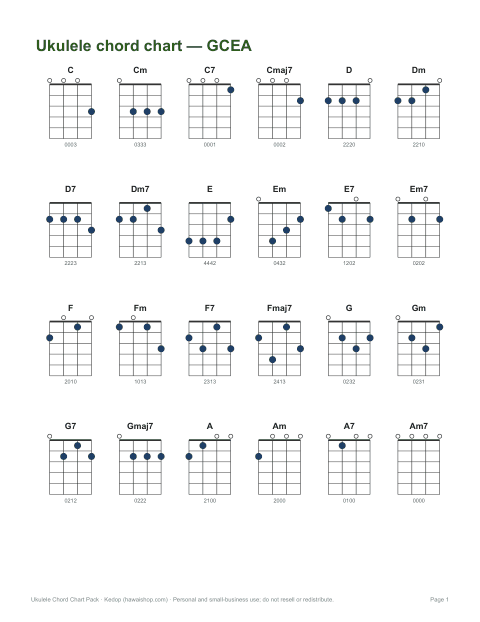
Reading a ukulele chord diagram
- The four vertical lines are the strings: G, C, E and A from left to right (as you look at the ukulele facing you).
- Horizontal lines are frets; the thick line at the top is the nut.
- A dot shows where to press; a number beside it may show which finger to use.
- An “0” above a string means play it open.
- Shapes are often written as four numbers — for example C = 0003 means G, C and E open and the A string at the 3rd fret.
Essential ukulele chords (GCEA)
| Chord | Frets (G C E A) | Chord | Frets (G C E A) |
|---|---|---|---|
| C | 0003 | Fmaj7 | 2413 |
| Cm | 0333 | G | 0232 |
| C7 | 0001 | Gm | 0231 |
| Cmaj7 | 0002 | G7 | 0212 |
| D | 2220 | Gmaj7 | 0222 |
| Dm | 2210 | A | 2100 |
| D7 | 2223 | Am | 2000 |
| Dm7 | 2213 | A7 | 0100 |
| E | 4442 | Am7 | 0000 |
| Em | 0432 | B♭ | 3211 |
| E7 | 1202 | B | 4322 |
| Em7 | 0202 | Bm | 4222 |
| F | 2010 | B7 | 2322 |
| Fm | 1013 | E♭ | 0331 |
| F7 | 2313 |
Numbers are the fret for each string from G (left) to A (right); 0 means open. Some chords have several common shapes — E, for example, is often played 1402 instead of 4442.
Your first four chords
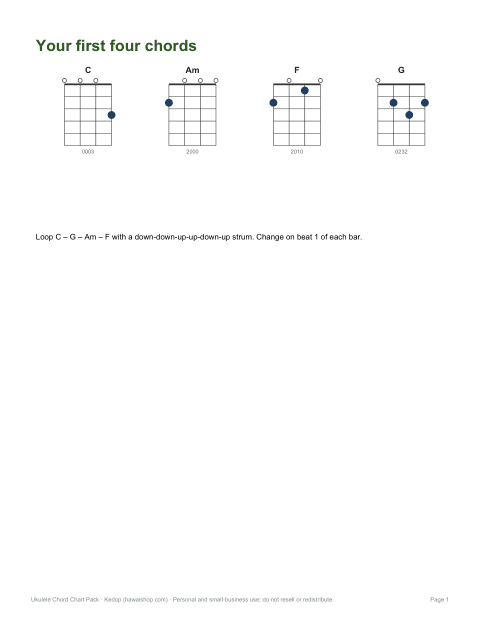
Start with C (0003), Am (2000), F (2010) and G (0232). With just these four you can play hundreds of pop songs, because the progression C–G–Am–F turns up again and again. Practise switching between two chords at a time — C to Am, Am to F, F to G — until each change takes less than a beat, then play all four in a loop with a simple down-down-up-up-down-up strum.
Common chord progressions
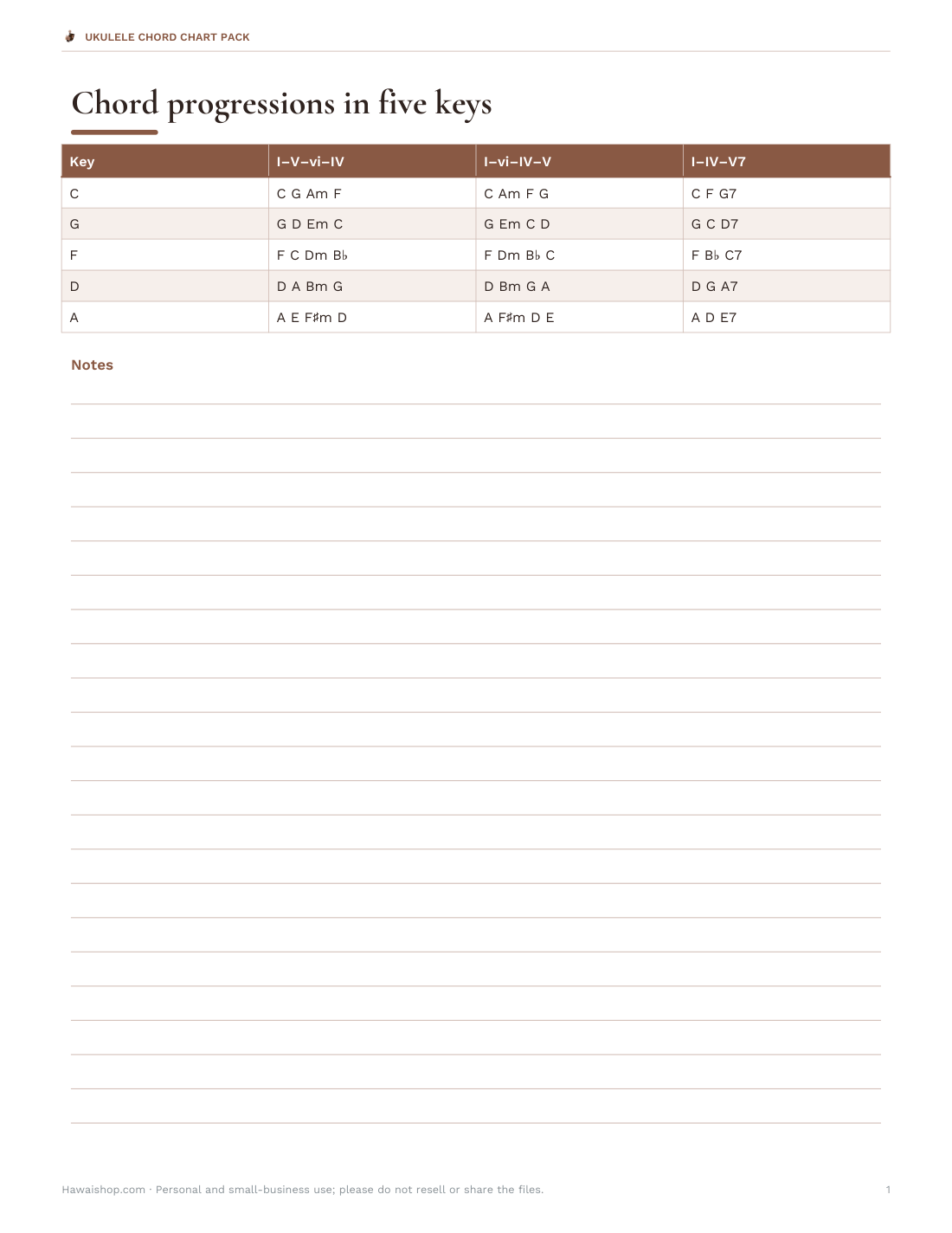
| Key | I–V–vi–IV (pop) | I–vi–IV–V (doo-wop) | I–IV–V7 (blues and folk) |
|---|---|---|---|
| C | C – G – Am – F | C – Am – F – G | C – F – G7 |
| G | G – D – Em – C | G – Em – C – D | G – C – D7 |
| F | F – C – Dm – B♭ | F – Dm – B♭ – C | F – B♭ – C7 |
| D | D – A – Bm – G | D – Bm – G – A | D – G – A7 |
| A | A – E – F♯m – D | A – F♯m – D – E | A – D – E7 |
Tuning your ukulele
Standard (C6) tuning from the top string is G4–C4–E4–A4, often remembered as “My Dog Has Fleas”. The G string is usually tuned higher than the C string (re-entrant tuning), which gives the ukulele its bright sound; some players use a low G for a fuller bass. Baritone ukuleles are tuned DGBE like the top four strings of a guitar, so the chord shapes in this pack sound different on them.
What’s in the pack
- Chord chart posters with diagrams for major, minor, 7th and maj7 chords.
- Beginner “first chords” sheet with C, Am, F, G and practice tips.
- Chord progression guide in five keys.
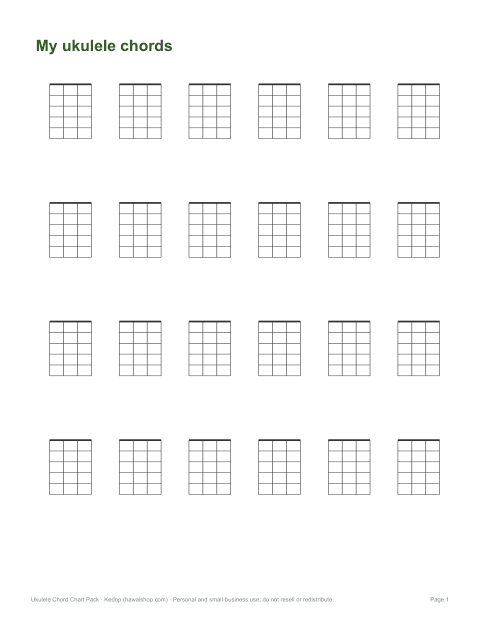
- Blank chord box pages to collect new shapes.
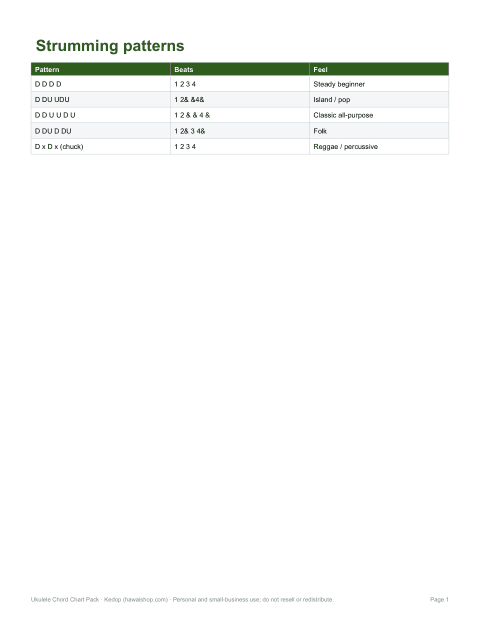
- Strumming pattern cheat sheet.
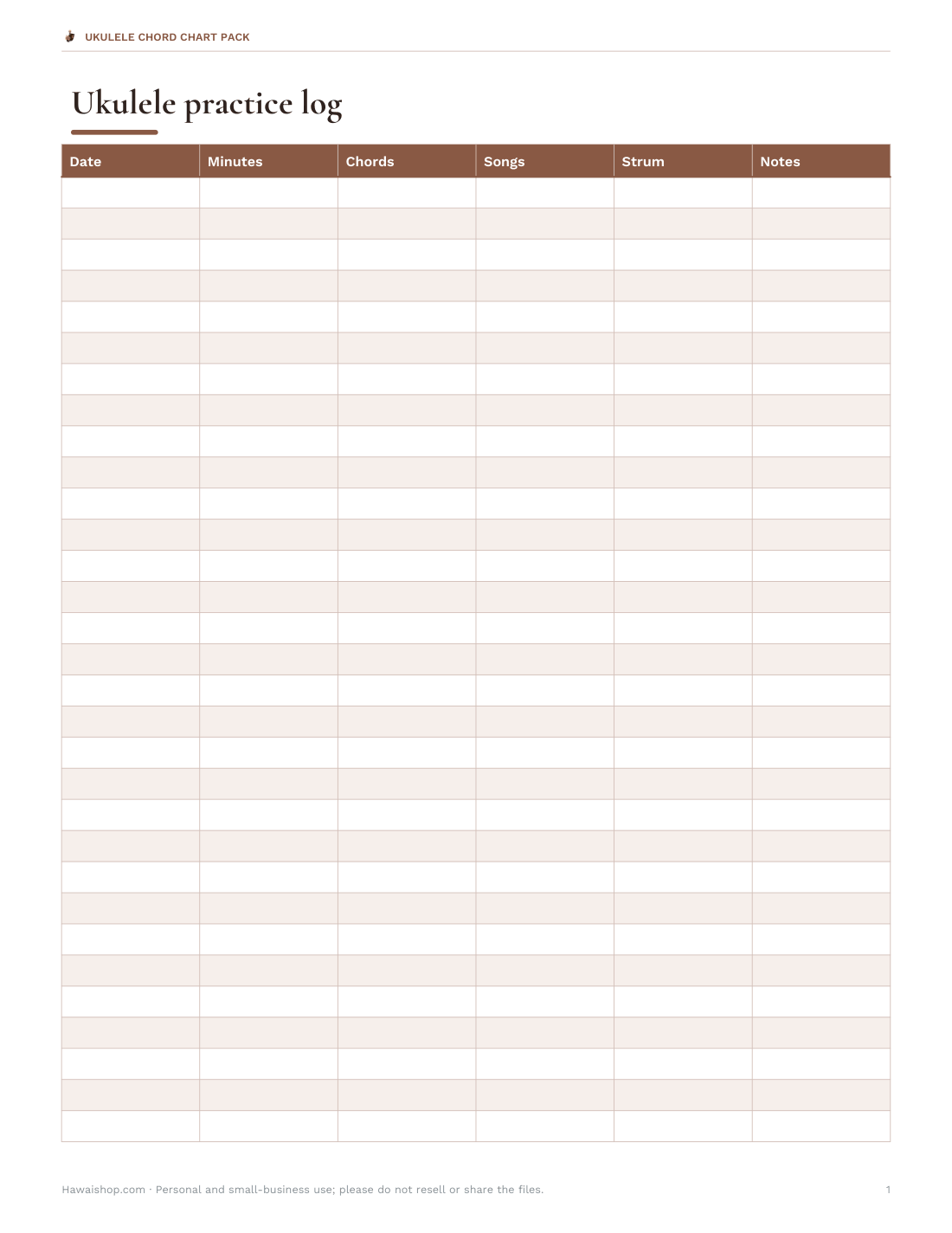
- Practice log (PDF and Excel).
Formats and printing
All charts print on US Letter or A4; the poster also scales to A3 or tabloid. Laminate the chord sheet and keep it in your case or on a music stand.
AI-assisted content
Chord shapes and guides were compiled with AI assistance and checked before publishing for standard GCEA tuning.
Frequently asked questions
What are the easiest ukulele chords?
C, Am, F and G — they cover hundreds of songs.
What tuning do the charts use?
Standard GCEA (re-entrant) tuning.
Do the charts work for baritone ukulele?
The shapes are the same but sound different because baritones are tuned DGBE.
What does 0003 mean?
The fret for each string from G to A — 0 is open, 3 is the 3rd fret.
Are blank chord boxes included?
Yes, to record new chords.
Is this a subscription?
No, it is a one-time download.